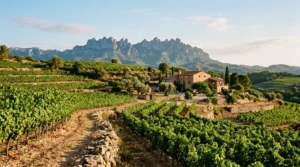
Cava and champagne are both sparkling wines made by the traditional method, with the second fermentation inside the bottle. The difference is place, grapes and rules. Champagne comes only from the Champagne region of France and is mostly Chardonnay and the Pinots. Cava is a Spanish wine, made mostly in the Penedès near Barcelona, from Macabeu, Xarel·lo and Parellada.
Key takeaways
- Cava and champagne share a method, but not a place, a grape list or a set of ageing rules.
- Champagne is French and protected by its region. Cava is protected by a Spanish designation of origin, DO Cava, and most of it is made in Catalonia, around Sant Sadurní d'Anoia in the Penedès.
- The classic cava grapes are Macabeu, Xarel·lo and Parellada. Champagne relies mainly on Chardonnay, Pinot Noir and Meunier.
- Basic cava must rest on its lees for at least nine months; Reserva, Gran Reserva and single-estate cavas age far longer.
- Sweetness is printed on the label, from Brut Nature to Dulce, so neither wine is automatically drier or sweeter than the other.
- Prosecco is a different wine again: Italian, made from Glera and usually fermented in a pressurised tank, not in the bottle.
- The Penedès is close enough to Barcelona for a day visit. The private Montserrat and Boutique Wineries: a Sensor Journey day costs €855, €1,085, €1,475 or €1,885 per group for up to 2, 4, 6 or 10 guests, with hotel pick-up.
Is cava the same as champagne?
No, although the two are close relatives. Both are made by what Spanish producers call the método tradicional and French producers call the méthode traditionnelle. A still base wine is bottled with a little sugar and yeast, sealed, and left to ferment a second time. The carbon dioxide from that second fermentation has nowhere to go, so it dissolves into the wine and becomes the bubbles.
What separates them is everything around that method. Champagne can only be made inside the Champagne region in north-eastern France, under French rules. Cava is made under Spanish rules set by its regulator, DO Cava, from a different list of grapes, in a much warmer Mediterranean climate. The result is a family resemblance rather than a copy.
A useful way to hold it in mind: the method is shared, the name is not. A Catalan sparkling wine made exactly like champagne is still cava, and a French sparkling wine made outside the Champagne region cannot be called champagne at all.
How is cava made?
The process has a handful of clear stages, and seeing them in a cellar makes the label on the bottle much easier to read.
The base wine
Grapes are picked, pressed and fermented into a still, dry white wine (or a rosé). Producers often blend several grapes or several plots at this stage. The base wine is fresh and fairly high in acidity, because the next steps will soften it.
The second fermentation in the bottle
The base wine is bottled with a measured mix of sugar and yeast, known as the tirage, and closed with a crown cap like a beer bottle. Inside, the yeast eats the sugar, makes a little more alcohol and releases carbon dioxide. This is the moment the wine becomes sparkling.
Ageing on the lees
When the yeast has finished, the dead yeast cells, called lees, settle inside the bottle. The wine stays in contact with them for months or years. This is where much of the character of a traditional-method sparkling wine comes from: notes often described as bread, brioche, toast or nuts, and finer, more persistent bubbles.
Riddling and disgorging
To remove the lees, bottles are gradually tilted neck down and turned so the sediment slides into the neck. Traditionally this was done by hand on wooden racks; today many cellars use machines that rotate large crates of bottles. The neck is then frozen, the cap removed, and the pressure pushes out a small plug of ice holding the sediment.
Dosage and corking
The bottle is topped up with a small amount of wine, sometimes with added sugar. This addition, the dosage, decides the sweetness category on the label. Then it receives its familiar cork and wire cage.
Which grapes are used in cava and in champagne?
Grapes are the clearest difference between the two wines, and they explain much of the difference in taste.
The traditional cava grapes
- Macabeu (also written Macabeo, and known as Viura in other parts of Spain) brings freshness and delicate fruit.
- Xarel·lo is the grape most closely linked to the Penedès. It gives body, structure and the ability to age well, and many growers see it as the backbone of their best wines.
- Parellada is lighter and floral, usually grown at higher altitudes, and adds finesse to a blend.
The rules also allow other varieties, including Chardonnay and Pinot Noir, and red grapes such as Garnacha, Monastrell and Trepat for rosé cava. Some producers work with a single grape; many blend.
The champagne grapes
Champagne is built mainly on Chardonnay, Pinot Noir and Meunier (often still called Pinot Meunier). A Blanc de Blancs is made only from white grapes, usually Chardonnay. A Blanc de Noirs is a white wine made from the black Pinots.
What that means in the glass
Because the grapes, soils and climate are different, the two wines rarely taste alike. Cava from native Catalan grapes is often described as having orchard fruit, citrus, herbal and almond notes. Champagne from a cooler northern region is often described as sharper in acidity with more pronounced bready notes. These are tendencies, not rules. A long-aged cava can be rich and complex, and a young champagne can be light and simple. Style depends heavily on the producer and on how long the wine spent on its lees.
How long does cava age?
The ageing rules are one of the most useful things to understand before you buy a bottle, because they tell you far more than the price tag.
Under DO Cava rules, basic cava must spend at least nine months on its lees before disgorging. Longer-aged categories carry their own names:
- Cava Reserva: at least 18 months on the lees.
- Cava Gran Reserva: at least 30 months on the lees.
- Cava de Paraje Calificado: wines from a single, specifically recognised estate plot, with at least 36 months on the lees and stricter rules on yields and production.
In recent years the regulator has also grouped wines into two broad families: Cava de Guarda for the youngest wines and Cava de Guarda Superior for Reserva, Gran Reserva and Paraje Calificado. You will see these terms on newer labels.
Champagne has its own minimums, and non-vintage champagne is generally aged longer than the most basic cava. That is one reason basic champagne tends to have more pronounced toasty notes than basic cava. Compare a Gran Reserva cava with a non-vintage champagne, though, and the cava may well have spent more time on its lees.
Is cava sweeter than champagne?
Not by default. Both wines use the same sweetness vocabulary on the label, and the level is decided by the dosage added just before corking. From driest to sweetest, the terms you will see on cava are:
- Brut Nature (no added sugar)
- Extra Brut
- Brut
- Extra Seco
- Seco
- Semiseco
- Dulce
Most cava sold outside Spain is labelled Brut, as is most champagne. Brut Nature is popular among Penedès growers, especially for long-aged wines, because the time on the lees gives the wine enough texture that it does not need sugar. Sources disagree on whether cava or champagne is generally "sweeter" or "more acidic", and the honest answer is that it depends on the bottle. Read the label first.
Cava vs prosecco: what is the difference?
Prosecco often comes up in the same conversation, but it is made in a different way.
- Place: prosecco comes from north-eastern Italy, in the Veneto and Friuli areas.
- Grape: it is made mainly from Glera.
- Method: most prosecco gets its second fermentation in large pressurised tanks rather than in individual bottles. This is often called the tank, Charmat or Martinotti method.
- Style: because the wine spends little time on lees, prosecco tends to be light, fruity and floral, with softer, frothier bubbles, and it is usually meant to be drunk young.
So of the three, cava and champagne are the two that share a production method. Prosecco is a different style of sparkling wine, not a cheaper version of the other two.
What do Corpinnat and Clàssic Penedès mean on a label?
In the Penedès you will also meet sparkling wines that do not say cava on the label at all, even though they are made in the same villages and by the same method.
Clàssic Penedès is a category within the still-wine designation of the Penedès. Its sparkling wines are traditional-method, made from organically grown grapes from the Penedès, and aged longer than the basic cava minimum.
Corpinnat is a collective brand created by a group of Penedès producers who chose to leave DO Cava and label their wines separately. Their rules focus on estate-grown, organic, hand-harvested grapes from a defined area of the Penedès, made entirely at the winery and aged for a long time on the lees.
Neither is a quality score in itself, but both signal producers who want their sparkling wine tied closely to the Penedès landscape. If you visit a small family estate, it may make cava, Clàssic Penedès or Corpinnat wines, and asking why is a good way to start a conversation in the cellar.
Where is cava made?
The DO Cava area covers municipalities in several Spanish regions, but the large majority of cava comes from Catalonia, and above all from the Penedès, the wine country between Barcelona, the Montserrat massif and the coast. The town of Sant Sadurní d'Anoia is widely known as the capital of cava, with large historic cellars running under the streets. Vilafranca del Penedès is the main town of the wider wine region.
The word cava itself means cellar, and the name is a reminder that the wine is defined by the time it spends underground, resting in the dark at a steady, cool temperature.
Sant Sadurní d'Anoia or a small family estate?
Visitors to the Penedès usually face a choice between two very different experiences.
The big houses in and around Sant Sadurní d'Anoia run large-scale cellar visits, sometimes with long tunnels and organised groups. They show the industrial side of cava and how a big production works.
A small family estate shows the farming side. The scale is human: one family, their vineyards, their cellar. You are more likely to hear about individual plots, why they grow Xarel·lo on one slope and Parellada on another, and how they decide when a wine is ready. For many travellers, this is the visit that makes the theory above make sense.
How does a winery visit near Barcelona work?
A typical cellar visit follows the life of the wine. You start in the vineyard or with the grapes, move to the winery where the base wine is made, then go down into the cellar where the bottles rest.
What to look at in the cellar
- Stacked bottles resting on their lees. These are wines still in their second stage of life, often closed with crown caps.
- Riddling racks or machines. Wooden racks with angled holes show how bottles were turned by hand. Many cellars keep them even if machines now do most of the work.
- Sediment in the neck. On bottles that are ready, you can sometimes see the lees gathered near the cap.
- The temperature and the quiet. Underground cellars stay cool and stable, and that stillness is a big part of how cava ages.
- The labels on finished bottles. Look for the ageing category and the sweetness term, now that you know what they mean.
Visiting without driving
The practical problem with any wine visit is the drive back. Wineries in the Penedès sit among vineyards, often some distance from a station, and nobody in a group wants to be the designated driver after a cellar visit. A vehicle with a guide solves this, because everyone travels together from Barcelona and back. There is a longer comparison of train and private options in the guide to day trips from Barcelona without a car.
Can you visit a cava cellar on a private day from Barcelona?
Yes. The private Montserrat and Boutique Wineries: a Sensor Journey day trip pairs Montserrat Monastery with a family-run boutique winery in the Penedès. It lasts 10 hours, with hotel pick-up and drop-off in Barcelona, and the vehicle and guide are reserved for your group alone.
The price is per group and depends on how many are travelling:
| Group size | Price per group | Duration | Pick-up |
|---|---|---|---|
| Up to 2 guests | €855 | 10h | Hotel or apartment in Barcelona |
| Up to 4 guests | €1,085 | 10h | Hotel or apartment in Barcelona |
| Up to 6 guests | €1,475 | 10h | Hotel or apartment in Barcelona |
| Up to 10 guests | €1,885 | 10h | Hotel or apartment in Barcelona |
Pairing a winery with Montserrat in one day
The day follows a natural order: the mountain in the morning, the vineyards in the afternoon. Montserrat Monastery sits high on the serrated massif, and it suits fresh legs and a clear head. The Penedès lies below and to the south, so the drive from the mountain to the vineyards is short compared with the drive out of Barcelona. A winery visit is then a calm way to spend the second half of the day before the drive back to your hotel. A fuller account of the route is in the guide to the private wine tour from Barcelona.
What is included and what is not
The listing covers Montserrat Monastery and a family-run boutique winery in the Penedès, a private vehicle and professional guide, and hotel pick-up and drop-off in Barcelona. Food and drinks are not included on any private tour, and gratuities are optional. What the estate pours on the day belongs to the winery and the tour listing, so check the tour page or send a message before booking if a particular style of cava matters to your group.
Private or shared?
If you are travelling alone or as a couple on a tighter budget, there is also a shared Montserrat and Penedès wine day trip. Shared Catalonia day trips with hotel pick-up cost €135 to €200 per person, in a small group of up to 8 people. The private day costs more for two, and the package price rises with group size, but the vehicle and guide are reserved for your group and the pace at each stop can flex around you. The core route stays close to the listed one. If you want a shorter day with Montserrat only, Essential Montserrat: Landscape, History and Spirituality runs 5 hours, from €835 per group, with no winery.
Practical planning advice
- Book ahead in busy seasons. A few days of notice is usually enough, but for spring and early autumn dates it is best to book at least a week ahead.
- Cancel or change freely. Every tour can be cancelled or moved to another date free of charge up to 96 hours before it starts. Refunds go back to the original payment method within a few business days; a no-show is not refunded. The full terms are on the cancellation policy page.
- Wear the right shoes. Montserrat involves walking on mountain paths, and cellars can be cool and slightly damp underfoot. A light layer helps in both places.
- Eat well before the cellar. Food is not part of a private day, so plan breakfast and lunch around the schedule your guide agrees with you.
- Send requests early. The route is set, but the pace can flex, and any requests can be sent before booking.
- Buy wine with the drive in mind. If you plan to carry bottles home, think about luggage space and airline rules before the visit.
Conclusion
Cava and champagne are made the same way, bottle by bottle, but they come from different countries, different grapes and different rules. Champagne belongs to its French region. Cava belongs mostly to the Penedès, a short drive from Barcelona, where Xarel·lo, Macabeu and Parellada grow below Montserrat and the wine rests in cool cellars for months or years before it reaches a glass.
To see that for yourself, the private Montserrat and Boutique Wineries: a Sensor Journey day collects your group from your Barcelona hotel and brings everyone back, priced per group from €855 for up to 2 guests. Book through the tour page, or send questions to Private Tour in Barcelona on WhatsApp at +34 632 93 79 41 or by email at [email protected].