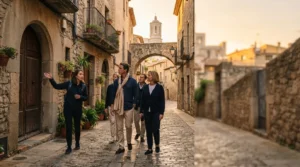
The Empuries ruins are the remains of Empúries, a Greek trading colony founded in the 6th century BC beside the sea near L'Escala, with a Roman town built on the hill above it. On a private day from Barcelona, The Roman and Greek heritage of Costa Brava with Panoramic Boat Ride pairs a guided walk of the site with a boat ride to the Medes Islands, for EUR 875 per group of up to 6.
Key takeaways
- Empúries is the only place in Catalonia where a Greek city and a Roman city sit side by side on one archaeological site, right on the shore of the Bay of Roses near L'Escala.
- The Greek town (known today as Neapolis, the "new city") grew from a first settlement on what was then an island, now the village of Sant Martí d'Empúries.
- The Roman city sits on the higher ground behind the Greek quarter, and only a part of it has been excavated.
- The Medes Islands are a small archipelago off L'Estartit, protected as a marine reserve and part of the Montgrí, Medes Islands and Baix Ter Natural Park.
- The private day costs EUR 875 per group of up to 6, lasts about 10 hours, and includes hotel pick-up in Barcelona, a guided walk of the Empuries ruins and a panoramic boat ride to the Medes Islands.
- Food and drinks are not included, and no entrance ticket is listed as included on this tour, so ask about the site entry when you book.
- For a Roman day with ticketed monuments, the private Roman Tarragona and Mediterranean Sitges day costs EUR 865 per group of up to 6 and includes entrance to the Roman Amphitheatre and the Roman Circus.
What are the Empuries ruins?
Empúries (Ampurias in Spanish, Emporion in Greek, Emporiae in Latin) is an archaeological site on the northern Costa Brava, just outside the town of L'Escala in the province of Girona. The Greek name Emporion means "market" or "trading post", which tells you what the place was for: a harbour where Greek merchants traded with the Iberian peoples of the interior.
The site is a branch of the Museu d'Arqueologia de Catalunya, with a small museum building between the Greek and Roman areas and a beach along its seaward edge.
Who founded Empúries?
Most sources date the foundation to around 575 BC. The settlers were Phocaean Greeks, from the Greek city of Phocaea on the coast of what is now Turkey, and they came by way of Massalia (Marseille), itself a Phocaean colony founded a little earlier.
Their first settlement stood on a small island at the mouth of the river, which the Greeks called Palaiapolis, the "old city". That island is now joined to the land and carries the walled village of Sant Martí d'Empúries. Within a few decades the colonists built a second town on the mainland just to the south, which archaeologists call Neapolis, the "new city". This is the Greek quarter you walk through today.
What is left of the Greek city, Neapolis?
Neapolis is the lower part of the site, closest to the sea. Most of what stands there dates from the Hellenistic period, roughly the 2nd and 1st centuries BC, built over earlier layers. The ground plan is easy to read: a main street, the outline of houses, cisterns for collecting rainwater, a market square (the agora) and a stoa, the long covered hall where trade and conversation happened.
At the southern end, close to the town gate, are the sanctuaries. The best known is the area linked to Asclepius, the Greek god of medicine. A marble statue of the god was found here in the early 20th century; the original is kept by the Museu d'Arqueologia de Catalunya, and a copy stands on the site so you can see it in its setting. A guide is useful here, because the temple platforms, altars and cisterns are low walls rather than standing buildings, and a short explanation turns them into a town.
What did the Romans add above it?
Rome arrived in 218 BC, at the start of the Second Punic War, when Gnaeus Cornelius Scipio landed at Emporion with Roman troops to open a front against Carthage in Hispania. In the following century a Roman town grew on the higher ground behind the Greek quarter, and the two communities later merged into a single Roman municipality, Emporiae.
The Roman city is much larger than the Greek one, and only a part of it has been excavated. What is open shows a forum with the base of a temple, a stretch of town wall with its gate, and large houses with mosaic floors. Walking from Neapolis up to the forum takes you from one civilisation to the next in a few minutes.
What is the seafront setting like near L'Escala?
The site faces the Bay of Roses. A boardwalk runs along the beaches below the ruins, and the old harbour area is marked by a stone breakwater. To the south is the town of L'Escala, known for its anchovies; to the north is Sant Martí d'Empúries, a small fortified village with a church and a quiet square, built on the old Greek island.
The site has little shade and the sea breeze can be strong, so bring a hat and a layer even on a warm day.
Is Empúries worth visiting?
Yes, if you like history you can walk through rather than read about. Empúries suits travellers who have seen Barcelona's Roman walls in the Gothic Quarter and want to see a complete ancient town plan, and anyone who wants a day on the Costa Brava that has more substance than a beach stop.
It is less suited to someone who wants grand standing monuments. Most structures are foundations and low walls, and a guide makes the difference between a field of stones and a readable town.
It also pairs well with the coast: ruins in the morning and the water in the afternoon keeps a long day varied for mixed groups.
What are the Medes Islands?
The Medes Islands (Illes Medes in Catalan) are a small archipelago of seven islets about a kilometre off the coast of L'Estartit, south of L'Escala. The largest is Meda Gran, which carries a lighthouse; the rest are rocky islets and reefs.
The islands are better known for what lies below the surface than above it. The waters around them have been protected for decades and are now part of the Montgrí, Medes Islands and Baix Ter Natural Park, which also covers the Montgrí massif and the coast around the mouth of the river Ter. Fishing is tightly restricted, diving is controlled with permits and quotas, and the result is a reserve widely described as one of the most important for marine life in the western Mediterranean. Groupers and red coral are among its best-known residents.
What do you see from a boat around the Medes Islands?
From the boat you see the limestone cliffs of the islets, sea caves and arches carved by the waves, the lighthouse on Meda Gran and the seabirds on the rocks. Looking back, the Montgrí massif rises behind L'Estartit.
On this private day, the boat ride is a panoramic trip around the islands rather than a dive or a snorkelling excursion. Boats in this area typically leave from the harbour at L'Estartit. Sea conditions decide how close a boat can go to the cliffs and caves, and on windy days the ride can be choppy.
How does the private Empúries and Medes Islands day run?
The tour is called The Roman and Greek heritage of Costa Brava with Panoramic Boat Ride. It is a private day trip: the vehicle and the guide are reserved for your group of up to 6, and the price is for the whole group, not per person.
Here is the route as listed on the tour page, in order:
- Hotel pick-up in Barcelona. Your driver-guide collects the group from a hotel or apartment in Barcelona. The address is confirmed at booking and the pick-up time agreed before the day.
- The drive north. Empúries is roughly 130 km from central Barcelona, which usually means a drive of around an hour and a half to two hours depending on traffic.
- Guided walk of the Empuries ruins. The guide walks you through the Greek quarter and up to the Roman city, covering the streets, houses, temples and market areas.
- Sant Martí d'Empúries. A stroll through the small fortified village on the site of the first Greek settlement, with its medieval wall and narrow lanes.
- Panoramic boat ride to the Medes Islands. A boat trip around the archipelago off L'Estartit.
- Swim in a Mediterranean cove. Free time at a cove for a swim, weather and season permitting.
- Return to Barcelona. Drop-off back at your hotel at the end of the day.
The whole day takes about 10 hours door to door.
Can the day be changed to suit the group?
Because nobody else shares the vehicle or the guide, the pace and the time at each stop can flex: a longer look at the Roman houses, a shorter stop in Sant Martí, a slower walk for older travellers. The core route stays close to the listed one, so this is not a custom itinerary. If you have a request, such as a lunch preference or extra time in the museum, send it before booking and the team can tell you what fits on the day.
What is included, and what costs extra?
Included on the day:
- Round-trip transport in a private vehicle
- A professional driver-guide for the full day
- Hotel pick-up and drop-off in Barcelona
- A guided walking tour of the Empúries archaeological site
- A panoramic boat ride to the Medes Islands
- Free time to swim in a Mediterranean cove
Not included:
- Food and drinks
- Entrance tickets unless stated
- Gratuities, which are optional
The tour page does not list an entrance ticket to the Empúries site among the inclusions, so check this point when you book rather than assume it. The site's own ticket prices and opening hours are set by the Museu d'Arqueologia de Catalunya and change by season, so look them up on the museum's official page close to your date.
How much does the private Empúries day cost?
The private day costs EUR 875 per group of up to 6. That single price covers the vehicle, the driver-guide, the hotel pick-up and the boat ride for everyone in your party, whether you travel as two or as six.
The table below sets it next to the other private Roman-heritage day and the shared alternative, using the prices and units exactly as published.
| Tour | Price | Unit | Duration | Ancient sites | Tickets included |
|---|---|---|---|---|---|
| The Roman and Greek heritage of Costa Brava with Panoramic Boat Ride | EUR 875 | per group of up to 6 | 10h | Greek and Roman Empúries, Sant Martí d'Empúries | Guided walk of the Empuries ruins and boat ride to the Medes Islands; no entrance ticket listed |
| Roman Tarragona and Mediterranean Sitges | EUR 865 | per group of up to 6 | 10h | Les Ferreres Aqueduct, Roman Forum, Roman Circus, Roman Amphitheatre | Entrance to the Roman Amphitheatre and Roman Circus |
| Costa Brava, Tossa de Mar and Panoramic Boat Ride (private) | EUR 865 | per group of up to 6 | 10h | Medieval walled Vila Vella in Tossa de Mar | Boat ride to Tossa de Mar |
| Shared Catalonia day trips with hotel pick-up | EUR 135 to 200 | per person | 5 to 12h | Depends on the route | Depends on the route |
Private prices are for the whole group, while shared prices are per person, so multiply a shared price by your group size before comparing.
Empúries or Roman Tarragona: which Roman-heritage day fits?
Both are private, both run about 10 hours with hotel pick-up, and they cost almost the same: EUR 875 per group for Empúries and the Medes Islands, EUR 865 per group for Roman Tarragona and Mediterranean Sitges. The difference is in what kind of ancient history you want, and what the afternoon looks like.
Choose Empúries and the Medes Islands if
- You want Greek history as well as Roman. Empúries is the place in Catalonia where Greek colonists first settled, and you see their town and the Roman town that followed on one site.
- You prefer an open-air site by the sea to monuments inside a modern city.
- Your group would enjoy time on the water and a swim in a cove after the ruins.
- You are visiting in the warmer months, when the boat ride and the cove are at their best.
Choose Roman Tarragona and Sitges if
- You want large Roman monuments that still stand. Tarragona was Tarraco, a provincial capital of Roman Hispania, and its Roman remains are part of a UNESCO World Heritage listing.
- You want monument entry sorted in advance: the private Roman Tarragona and Mediterranean Sitges day includes entrance to the Roman Amphitheatre and the Roman Circus.
- You like a town walk in the afternoon. Sitges brings modernist houses, shopping lanes, a seafront promenade and free time at the beach.
- You are travelling outside the warmer months, when a boat ride and a swim are less appealing.
The site's own guide to the private Tarragona and Sitges tour covers the Tarragona route stop by stop if you want to compare the two in detail.
What about Tossa de Mar instead?
If the sea matters more than the ruins, the other private Costa Brava day, Costa Brava, Tossa de Mar and Panoramic Boat Ride, costs EUR 865 per group of up to 6 and focuses on Lloret de Mar, a boat ride to Tossa de Mar and Sant Feliu de Guíxols. The post on choosing between Tossa de Mar and Empúries for a private Costa Brava day sets those two coast days side by side.
Are there other Roman ruins near Barcelona?
Yes. Barcelona began as the Roman colony of Barcino, and parts of its walls and the columns of the Temple of Augustus survive in the Gothic Quarter. For a full day outside the city, the two clear choices are Tarragona to the south, with standing monuments in a living city, and Empúries to the north, with a complete Greek and Roman town plan by the sea.
Can you visit Empúries from Barcelona without a tour?
You can, though it takes planning. L'Escala has no train station, so public transport means a regional bus, or a train plus a bus or taxi, with fewer connections outside summer.
Combining Empúries with the Medes Islands on your own in a single day is harder still, because the boats leave from L'Estartit, a separate town a short drive south. Without a car you would need a taxi between the two and a careful eye on the last bus back. The post on getting to the Costa Brava from Barcelona without a car explains the public transport options in more detail.
A private day replaces that with one vehicle from your hotel to the ruins, the harbour, the cove and back.
Practical planning advice for the Empúries day
When is the best time to go?
Late spring, summer and early autumn suit this day best, because the boat ride and the swim depend on calm, warm weather. Summer has the warmest water and the most visitors; spring and early autumn are cooler for walking the ruins.
In winter, wind and sea make a boat ride less predictable, so the Tarragona and Sitges day may be the steadier choice.
What should you bring?
- A swimsuit and towel for the cove
- Sun protection and a hat, since the site has little shade
- Comfortable walking shoes with good grip; the paths across the ruins are uneven gravel and stone
- A light layer or windproof jacket for the boat
- Water, and money for lunch and any entrance fee not listed as included
How far ahead should you book?
A few days of notice is usually enough. For spring and early autumn dates, book at least a week ahead.
What if your plans change?
Every tour can be cancelled free of charge, or moved to another date, up to 96 hours before it starts. Refunds go back to the original payment method within a few business days. A no-show is not refunded. The cancellation policy has the full terms.
Is it suitable for children and older travellers?
Mostly, yes. The ruins are largely level with some slopes, and the guide can slow the pace. Stepping on and off the boat is worth mentioning in advance if anyone has limited mobility.
Conclusion
The Empuries ruins give you Greek and Roman history in one walk by the sea, and the Medes Islands add an afternoon on the water. The private day costs EUR 875 per group of up to 6, with hotel pick-up in Barcelona and about 10 hours from door to door.
You can check the route and book on The Roman and Greek heritage of Costa Brava with Panoramic Boat Ride page. For questions about dates or requests, message WhatsApp on +34 632 93 79 41 or write to [email protected].