The Girona Jewish Quarter, known locally as El Call, is a small knot of steep stone lanes in the old town of Girona, wrapped around Carrer de la Força and the Cathedral steps. It is worth visiting on a private day trip from Barcelona. The Medieval Girona and Costa Brava (private) tour lists the Jewish Quarter by name.
Key takeaways
- El Call is the medieval Jewish quarter of Girona, one of the best preserved in Catalonia, set inside the old town between the Cathedral and the Onyar river.
- Its spine is Carrer de la Força, a narrow street that follows the line of the old Roman road through the city.
- The Museum of Jewish History sits in the heart of the quarter. Entry to it is not listed on any of the private tours described here.
- The Medieval Girona and Costa Brava (private) tour lists the Girona old town and the Jewish Quarter, then continues to Pals and Calella de Palafrugell.
- Medieval Girona and Dali Museum in Figueres (private) and Montserrat, Girona and Costa Brava Private Tour both include a Girona old town walk.
- Private tours are priced per group by group size, in packages for up to 2, 4, 6 or 10 guests, with hotel pick-up in Barcelona.
- Every tour can be cancelled or moved free of charge up to 96 hours before it starts.
What is the Girona Jewish Quarter?
The Girona Jewish Quarter is the part of the old town where the city's Jewish community lived for several centuries in the Middle Ages. In Catalan the word for such a quarter is "call", so locals and signs simply say El Call, or El Call de Girona.
The community grew up close to the Cathedral and the seat of royal and church power, which was common for Jewish quarters in medieval Catalan towns. Historians generally place a settled Jewish neighbourhood here from around the twelfth century, with families living along Carrer de la Força and the lanes that climb off it.
For a long period Girona's community was one of the most important in Catalonia, second only to Barcelona's. It is best known for its scholars. Moses ben Nahman, often called Nahmanides, was a son of Girona who lived and taught here in the thirteenth century and became one of the most influential rabbis and commentators of medieval Europe. Girona is also closely linked with the study of Kabbalah, the Jewish mystical tradition, which was taught and written about here in that period.
The story ended at the close of the fifteenth century, when the Jews of the Spanish kingdoms were expelled. The houses were sold or taken over, doorways were blocked, and the quarter was absorbed into the Christian city. For a long time its history was half forgotten. From the later twentieth century onward, the city restored the area and brought its past back into view, and today the Call is one of the most visited parts of Girona.
Is El Call the same as the old town?
Not quite. El Call is one part of the Barri Vell, the old town of Girona. The old town also takes in the Cathedral, the Basilica of Sant Feliu, the Arab Baths, the stretch of medieval walls you can walk along, and the painted houses facing the Onyar. When a tour lists a Girona old town walk, the route goes through the Barri Vell. El Call sits right in the middle of it, which is why it is so easy to pass through without noticing where it begins and ends.
What to see in the Jewish Quarter in Girona
The Call is not a single sight with a ticket desk. It is a set of streets, courtyards and stairways you walk through, and much of what makes it memorable is the shape of the place itself.
Carrer de la Força
Carrer de la Força is the street to start with. It runs roughly north to south along the slope below the Cathedral and follows the course of the old Roman road that once crossed Girona. It is long, slightly curving and lined with tall stone houses, shops and doorways.
Walk it slowly. The paving, the iron balconies and the narrow side openings give a sense of how tightly the medieval city was packed onto the hillside. Several of the lanes leading off Carrer de la Força belonged to the Jewish quarter, and the Museum of Jewish History has its entrance in this part of the street.
The narrow lanes and stairways
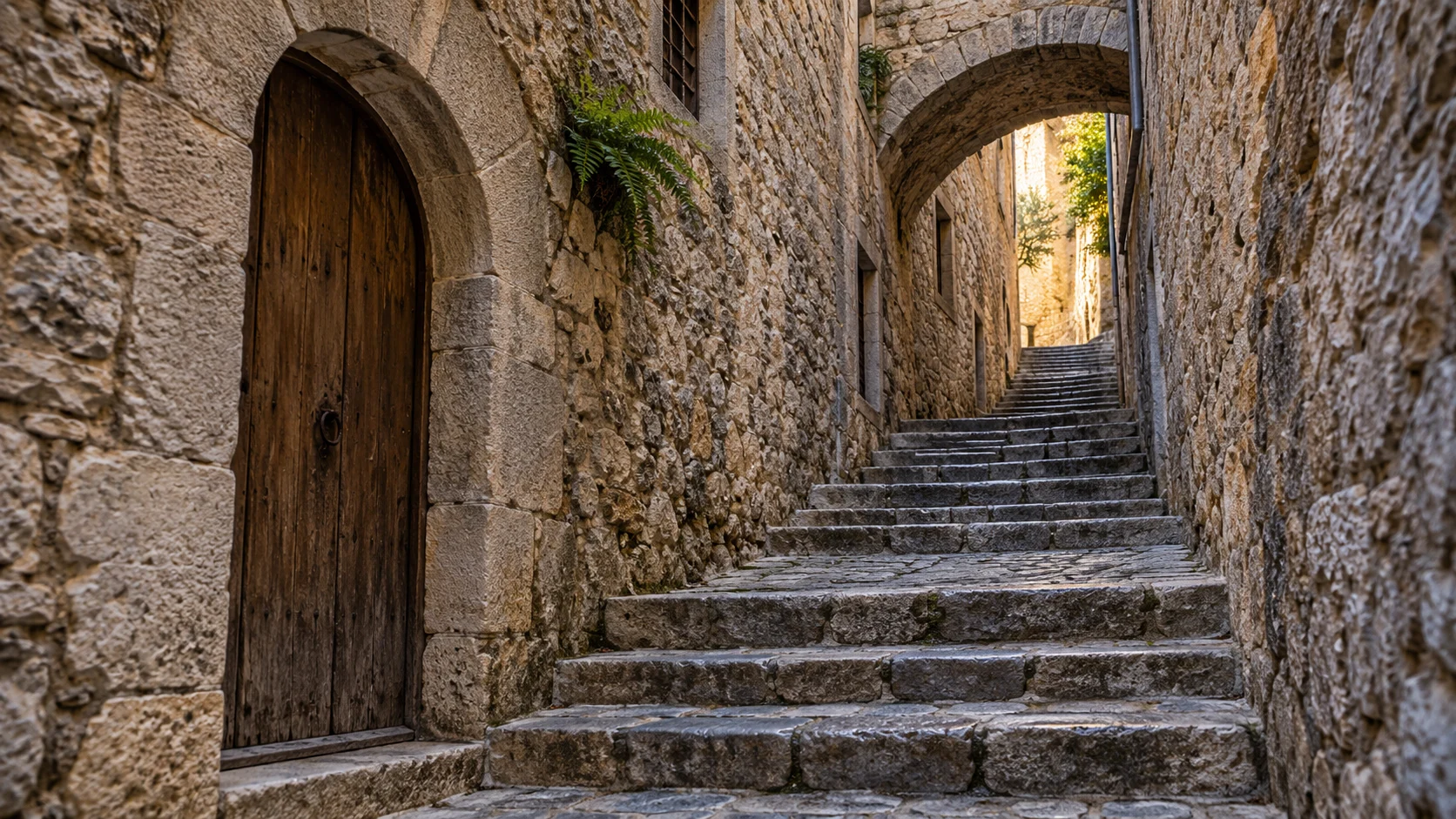
The lanes that branch off Carrer de la Força are where El Call feels most like itself. Some are barely wider than outstretched arms. They climb in steps, turn under arches and open into small courtyards before narrowing again.
The best known is Carrer de Sant Llorenç, a stepped lane with high walls that often appears in photographs of Girona. Others wind uphill toward the Cathedral. Walking these with a guide is useful, because without one it is easy to take the wrong turn and miss the most atmospheric passages, or simply not know what you are looking at.
Traces in the stone
You will not find a standing medieval synagogue on the street. What remains of the community is mostly in the fabric of the buildings: the layout of the lanes, old doorways, and in some places the small groove on a door frame where a mezuzah, a small case holding a parchment scroll, may once have been fixed. A guide can point out the details that are easy to walk past.
The Museum of Jewish History
The Museum of Jewish History is in the centre of the Call, inside a group of restored medieval buildings that are thought to have been part of the community's later synagogue complex. Its collection covers daily life, religious practice, the scholars of Girona and the expulsion. Among the best known items are medieval Hebrew tombstones recovered from the Jewish cemetery on the hill of Montjuïc in Girona.
Entry to the museum is not included in any of the private tours on this page. If seeing the inside of the museum matters to your group, mention it when you send your booking request so the timing of the day can be discussed. Check the museum's own information for current opening times before you travel.
How El Call sits next to the Cathedral, the walls and the river
One of the things that surprises first-time visitors is how compact Girona's old town is. El Call is not a separate district you drive to. It is woven into the same few hundred metres of hillside as the city's other landmarks.
The Cathedral steps
At the upper edge of the quarter rises the Cathedral of Girona, reached by a broad flight of Baroque steps that climbs from the Plaça de la Catedral. The steps are one of the most photographed spots in the city, and they also appeared in Game of Thrones, which our guide to the Girona Game of Thrones locations covers in more detail.
The lanes of the Call lead up toward this square, so a walk through the quarter often ends, or begins, at the foot of the Cathedral steps. Standing at the top gives a view back over the rooftops of the old town.
The medieval walls
Behind the Cathedral and along the eastern side of the old town runs the line of Girona's medieval walls. A walkway on top of them, the Passeig de la Muralla, lets you look down over the Call, the Cathedral and the newer city beyond, with the hills behind. Sections of the walls are open to walk, and on a clear day the views are some of the best in Girona.
Not every old town walk includes time on the walls, and the walkway involves stairs and uneven surfaces. If you would like to include part of it, ask before booking. On a private tour the pace can flex, though the core route stays close to the one listed.
The Onyar river houses
Below the Call, on the western side of Carrer de la Força, the old town drops down to the Onyar river. The houses along the riverbank are painted in shades of ochre, red, yellow and orange, with their backs facing the water. Several footbridges cross the river, including a red iron bridge that gives one of the classic views of the facades.
From the riverside you can walk up through narrow passages into the Call in a few minutes. That short climb, from the open river to the closed stone lanes, shows how close together these different faces of Girona are.
Which private day trips walk Girona's old town?
Three private day trips from Barcelona include Girona. All three collect your group from a hotel or apartment in Barcelona in a vehicle reserved for you, with your own guide, and bring you back at the end. They differ in what fills the rest of the day.
Medieval Girona and Costa Brava (private)
This is the tour to choose if El Call is a priority. The Medieval Girona and Costa Brava (private) tour lists the Girona old town and the Jewish Quarter, then heads to the medieval village of Pals and the seaside town of Calella de Palafrugell on the Costa Brava. It runs about 10 hours.
The balance of the day is medieval stone in the morning and the coast later on, which suits groups who want history and sea views without a museum visit.
Medieval Girona and Dali Museum in Figueres (private)
The Medieval Girona and Dali Museum in Figueres (private) tour includes a Girona old town walk and the entrance to the Dali Theatre-Museum in Figueres. It runs about 10 hours. The old town walk passes through the historic centre of Girona, and the second half of the day is given to Dali.
This tour does not list the Jewish Quarter by name. If you want time in El Call specifically, send the request before booking so it can be discussed.
Montserrat, Girona and Costa Brava Private Tour
The Montserrat, Girona and Costa Brava Private Tour is the longest of the three, at about 11 hours. It includes the Montserrat Monastery and Basilica, a Girona old town walk and the Costa Brava coastline. Because the day covers three regions, the time in Girona is shorter than on the two tours above.
As with the Figueres tour, the Jewish Quarter is not listed by name. The Montserrat, Girona and Costa Brava Private Tour page shows how the three regions fit into one day.
How much does a private Girona tour from Barcelona cost?
Private tours are priced per group, not per person, and the price depends on how many people are in your group. There are four packages: up to 2, up to 4, up to 6 or up to 10 guests. Here are the three private day trips that include Girona.
| Private tour | Duration | Up to 2 guests | Up to 4 guests | Up to 6 guests | Up to 10 guests |
|---|---|---|---|---|---|
| Medieval Girona and Costa Brava (private) | 10h | €850 per group | €1,099 per group | €1,450 per group | €1,850 per group |
| Medieval Girona and Dali Museum in Figueres (private) | 10h | €825 per group | €1,050 per group | €1,400 per group | €1,800 per group |
| Montserrat, Girona and Costa Brava Private Tour | 11h | €845 per group | €1,085 per group | €1,425 per group | €1,825 per group |
Each package price covers the whole group, with the vehicle and guide reserved for you and hotel pick-up and drop-off in Barcelona. The Medieval Girona and Dali Museum in Figueres (private) tour also includes the Dali Theatre-Museum entrance. Food and drinks are not included on any private tour, and gratuities are optional.
For a wider look at how the two Girona day trips compare, see our post on choosing a private Girona tour from Barcelona.
Is the Girona Jewish Quarter worth visiting?
For most visitors, yes. El Call is one of the most complete medieval quarters in Catalonia, and it is small enough to take in properly within a day trip. A few things make it worth the journey.
It is real, not reconstructed. The lanes are the same ones that existed in the Middle Ages, and people still live and work in them.
It tells a story you do not get in Barcelona. Barcelona also had a medieval Jewish quarter, but much less of its street pattern and feel survives. In Girona the whole hillside setting is still there.
It connects with everything else in the old town. In a single walk you can move from El Call to the Cathedral steps, along the walls and down to the river houses.
It works for different interests. Some groups come for the history and the scholars, some for the architecture and photography, some because they watched Game of Thrones. The lanes reward all three.
Who might find it less suited? Anyone who struggles with stairs and steep slopes. Many of the lanes are stepped, and the cobbles can be slippery after rain. On a private tour the guide can adjust the pace and avoid the steepest passages where possible, but some climbing is part of the experience.
Practical planning for a Girona old town walk
Getting there from Barcelona
Girona is north of Barcelona, and on a private day trip the drive is part of the day. Your guide and vehicle collect you from your hotel or apartment in Barcelona; the address is confirmed at booking and the pick-up time agreed before the day. If you are comparing a private tour with travelling by train, our post on how to get to Girona from Barcelona sets out the differences.
What to wear
Wear shoes with good grip. The lanes of the Call are paved with stone, many are stepped, and some stay damp in the shade. Bring a light layer, since the narrow streets can feel cooler than the open squares. If your group plans to go inside the Cathedral or other religious buildings, covered shoulders are a sensible choice.
Timing the walk
Girona's old town is busiest in the middle of the day, especially in summer and at weekends. Morning light in the lanes is soft, and the Cathedral steps are quieter early. On a private tour the pace and time at each stop can flex, so you can tell the guide if you would rather linger in the Call and spend less time elsewhere. The core route still stays close to the listed one.
Booking ahead
A few days of notice is usually enough for a private tour. For spring and early autumn dates, book at least a week ahead. Free cancellation or a free date change is available up to 96 hours before the tour starts, on every tour. Refunds go back to the original payment method within a few business days. A no-show is not refunded.
Questions to send before booking
Because the three Girona tours differ, it helps to say what matters to your group when you enquire:
- Whether El Call is a priority, so you can choose the tour that lists the Jewish Quarter.
- Whether anyone in the group has limited mobility or finds stairs difficult.
- Whether you want time for the Museum of Jewish History, which is not included.
- Whether you would like a stop on the walls or by the river.
Requests can be sent before booking, though a custom itinerary is not promised.
Private or shared: how the Girona day compares
Shared Catalonia day trips with hotel pick-up are also offered, in small groups of up to 8 people, priced per person. They follow a fixed timetable shared with other travellers.
A private tour reserves the vehicle and the guide for your group alone. That changes the feel of a Girona old town walk. You can stop for photographs on the Cathedral steps without holding anyone up, walk the steep lanes of the Call at your own pace, and ask the guide as many questions about the community and its scholars as you like. Per person, a private day usually costs more than a seat on a shared trip, even in the larger packages. What you pay for is your own vehicle and guide and your own pace.
Conclusion
The Girona Jewish Quarter is a compact, walkable piece of medieval Catalonia, with Carrer de la Força at its centre, the Cathedral steps above, the walls behind and the Onyar river houses below. For a private day that lists El Call by name, the Medieval Girona and Costa Brava (private) tour is the natural choice, while the Figueres and Montserrat routes include a Girona old town walk.
To check a date or ask about your group, message WhatsApp on +34 632 93 79 41 or email [email protected]. Each tour page also has a Book this tour form.