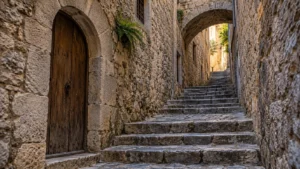
The Girona city walls walk follows the Passeig de la Muralla, a raised path along the old town's medieval walls with views over rooftops, the Onyar and Girona Cathedral. Expect stairs, uneven paving and narrow stretches. Walk it on your own, or ask about it before booking a private Girona day from Barcelona with hotel pick-up.
Key takeaways
- The Muralles de Girona wrap around the eastern and southern edge of the old town, and the walkway on top is known locally as the Passeig de la Muralla.
- The walk is about stairs, not distance: short steep flights up to towers, worn stone underfoot and a few tight passages where two people barely pass.
- Starting at the southern end and finishing near Girona Cathedral and the Jardins dels Alemanys puts you a few minutes from the Cathedral steps and the Jewish Quarter when you come down.
- Access rules can change, so check girona.cat, the Girona City Council website, for current access before you go.
- Three private day trips from Barcelona include a Girona old town walk. None lists the walls as a stop, but the pace on a private tour can flex, and you can send a request before booking.
- Private tours are priced per group, by group size, in packages for up to 2, 4, 6 or 10 guests. Food and drinks are not included.
What is the Girona city walls walk?
Girona grew inside a ring of defensive walls. Parts of the line go back to the Roman town, and much of what stands today comes from the medieval city, which extended and rebuilt the walls as Girona grew. Later centuries added repairs and reinforcement, and the modern city restored long sections so people could walk along the top.
That walkway is what visitors mean by the Girona city walls walk. You climb onto the walls at one of several access points, then follow a path that runs along the battlements, drops into gaps, climbs into towers and turns corners where the old line changed direction.
Unlike a museum, the walls do not tell their story through signs and displays. The value is in the position. From up there you look down into the tight streets of the Barri Vell, across to the hills behind the city, and back toward the bell tower and facade of Girona Cathedral.
Is it a hike or a stroll?
Somewhere in between. The walk is not long or remote, and you are never far from the streets below. But it is not a flat promenade either. The path changes level many times, and most of those changes are made with stone steps rather than ramps.
Anyone comfortable with stairs will enjoy it. Anyone who finds steps tiring should pick one short section, or use the lower-effort route described further down.
Where does the walk start, and which direction is easier?
There are access points at both ends of the main stretch and a few along the way. The two most useful are:
- The southern end, at the edge of the old town above the river, close to the streets that lead down to the Onyar bridges.
- The northern end, near Girona Cathedral and the Jardins dels Alemanys, a quiet garden tucked against the walls.
Why walking toward the Cathedral works well
Both directions involve climbs, so there is no truly "easy" way. The practical case for walking from south to north is what happens when you come down.
If you finish near the Jardins dels Alemanys, you step off the walls a short walk from the Cathedral. From there you can go down the famous Cathedral steps, wander into the Jewish Quarter, known as the Call, and keep going toward the river. Everything you probably came to Girona to see is downhill and close by.
Walk the other way and you finish at the southern end, which is fine if you want to cross a bridge and head for lunch, but you then have to climb back up into the old town for the Cathedral.
For a closer look at the Cathedral itself, its nave and cloister, read our guide to Girona Cathedral and how to visit it.
The walls, section by section
The walk is easier to plan if you think of it in three parts. The table describes what each one gives you and how hard it feels. It uses no distances or step counts on purpose: conditions underfoot matter more than numbers here.
| Wall section | What you see | Effort |
|---|---|---|
| Southern end (river side) | Rooftops of the old town, the newer town across the Onyar, first glimpses of the Cathedral bell tower | Moderate: an initial climb onto the walls, then gentler stretches |
| Middle stretch along the eastern edge | The hills behind Girona, the old town spread below, towers you can climb for wider views | The hardest part: repeated short, steep flights and narrow passages |
| Northern end near the Cathedral and the Jardins dels Alemanys | The closest views of Girona Cathedral, the garden below, the rooftops of the Call | Moderate: some stairs, then an easy exit into the garden and the Cathedral area |
Towers and viewpoints
Several towers along the line have stairs inside or alongside them, and the view from the top is usually wider than from the walkway. The steps in these towers tend to be the steepest and narrowest on the whole walk. If you are short of time or energy, climb one tower near the Cathedral end rather than every tower you pass.
Photography
The best pictures usually come from the middle and northern sections, where the Cathedral rises above the rooftops. Softer light early or late in the day helps with the pale stone. In the middle of a bright day, the walls offer little shade and the light is flat.
Are the Girona walls free?
Access rules for the walls are set by the city. Check girona.cat, the website of Girona City Council, for current access, any closures and any work on particular sections before you go. Sections can close for repairs, events or bad weather, so it is worth looking on the morning of your visit.
The walls have no guided commentary built in, which is one reason many visitors prefer to walk the old town with a guide first and climb the walls afterwards, once they know what they are looking at.
How long should you give the walls?
Treat the full walk as a real part of your Girona time, not a quick detour between two sights. The stairs, the stops for photos and the passing places in narrow sections all slow you down.
A single section is much shorter. If you only have a little time, the northern stretch near the Cathedral gives you the strongest views for the least climbing, and it ends where most people want to be next.
Girona walls with kids, seniors or limited mobility
Children
Older children usually love the walls: towers, battlements and narrow passages feel like a castle game. Keep a hand on younger children near low parapets and on steep steps, and avoid the walk in strong wind.
Pushchairs and wheelchairs
The walls are not a good place for a pushchair or a wheelchair. Most level changes are made by stairs, paving is uneven, and some passages are narrow. A baby carrier works far better than a pushchair if you want to do a short section.
Seniors and anyone who finds stairs hard
Choose one short section near an access point, or skip the walls entirely and use the alternative below. There is no shame in missing the climb. The old town below the walls is the real heart of Girona.
A lower-effort alternative
If the stairs are not for you, spend that time at street level instead:
- Walk through the Jewish Quarter, the Call, with its narrow lanes and stepped alleys at a slower pace.
- See Girona Cathedral from the square at the foot of the steps, without climbing them.
- Cross the Onyar on one of the footbridges for the classic view of the coloured houses above the water.
- Sit in the Jardins dels Alemanys, right beside the walls, and see them from below.
You still see the walls, just from the ground, and you keep your energy for the rest of the day.
Walls or Onyar bridges: which views should you choose?
The two classic viewpoints in Girona give you very different pictures.
The walls look inward and down. You see the old town as a whole: rooftops, the Cathedral, the line of the walls bending away, and the hills behind. It is the view that explains how the city was built.
The Onyar bridges look sideways at the old town's river front. You see the coloured houses hanging over the water with the old town rising behind them. It is the image on most Girona postcards, and it takes almost no effort to reach.
If you only have a short time in Girona, and especially on a full-day trip from Barcelona that also covers Figueres or the Costa Brava, the bridges win on effort. If you have a little more time and like a climb, the walls give you the bigger picture. We cover the river front in detail in our guide to the Girona Onyar houses and bridges.
Rain, heat and wind on the walls
Rain
Wet stone steps are slippery, and some of the walkway has no cover. In steady rain, keep to the old town streets instead. After a short shower, wait for the paving to dry if you can, and wear shoes with real grip.
Heat
The walls have little shade. On a hot day, go early or later in the afternoon, carry water and wear a hat. In the middle of a summer day the climb is tiring for most people.
Wind
Strong wind is the one condition that makes the walls genuinely unpleasant, especially in the towers and on exposed corners. Sections can be closed in bad weather, which is another reason to check girona.cat before you go.
Can you walk the Girona walls on a day trip from Barcelona?
Yes, if you plan the day around it. Girona is an easy day trip from Barcelona, and the old town is compact enough that the walls, the Cathedral and the Jewish Quarter sit close together.
The question is what else you want in the same day. A Girona day usually pairs the old town with Figueres and the Dali Theatre-Museum, or with Costa Brava villages, or with Montserrat. Those pairings fill most of the day, so a full walls walk competes with everything else.
Which private tours include a Girona old town walk?
Three private day trips from Barcelona include time in Girona's old town. None of them lists the walls as a stop. What a private tour does give you is a vehicle and guide reserved for your group, so pace and time at each stop can flex, though the core route stays close to the listed one. If the walls matter to you, send a request before booking and the team can tell you what is realistic on your date.
| Private tour | Duration | Girona element (as listed) | Other highlights | Price per group (up to 2 / 4 / 6 / 10 guests) |
|---|---|---|---|---|
| Medieval Girona and Dali Museum in Figueres (private) | 10h | Girona old town walk | Dali Theatre-Museum entrance included | €825 / €1,050 / €1,400 / €1,800 |
| Medieval Girona and Costa Brava (private) | 10h | Girona old town and Jewish Quarter | Pals village, Calella de Palafrugell | €850 / €1,099 / €1,450 / €1,850 |
| Montserrat, Girona and Costa Brava Private Tour | 11h | Girona old town walk | Montserrat Monastery and Basilica, Costa Brava coastline | €845 / €1,085 / €1,425 / €1,825 |
All three include hotel pick-up in Barcelona, a private vehicle for the day and a guide. The price is per group and depends on group size, in packages for up to 2, 4, 6 or 10 guests. Food and drinks are not included on any private tour, and gratuities are optional.
Girona with Figueres
The Medieval Girona and Dali Museum in Figueres private tour runs 10 hours and splits the day between Girona's old town and Figueres. It is the only one of the three with an entrance ticket included: the Dali Theatre-Museum. Prices are €825 per group for up to 2 guests, €1,050 for up to 4, €1,400 for up to 6 and €1,800 for up to 10.
Because the museum visit is a set part of the day, Girona time is the part that can stretch or shrink. If you would rather use some of it on the walls, say so when you send your request.
Girona with Pals and Calella
The Medieval Girona and Costa Brava private tour also runs 10 hours. It pairs Girona's old town and Jewish Quarter with the medieval village of Pals and the seaside at Calella de Palafrugell. Prices are €850 per group for up to 2 guests, €1,099 for up to 4, €1,450 for up to 6 and €1,850 for up to 10.
This is the route where the old town gets the most explicit attention, with the Jewish Quarter named on the itinerary. Our guide to Girona's Jewish Quarter on a private day trip explains what you see there.
Girona with Montserrat
The Montserrat, Girona and Costa Brava Private Tour is the longest of the three at 11 hours. It covers Montserrat Monastery and Basilica, a Girona old town walk and the Costa Brava coastline. Prices are €845 per group for up to 2 guests, €1,085 for up to 4, €1,425 for up to 6 and €1,825 for up to 10.
With three regions in one day, time in Girona is the tightest here. If the walls are a priority, one of the two 10-hour Girona routes is usually the better fit, and the Onyar bridges are the more realistic viewpoint on this one.
What the price per group covers
On each of these days you pay one price for the whole group, set by the package size. That price covers:
- Pick-up from your hotel or apartment in Barcelona, in a vehicle reserved for your group, and the drive back at the end of the day. The address is confirmed at booking and the pick-up time agreed before the day.
- A professional guide for the day.
- The entrance tickets listed for that tour. On these three routes, only the Girona and Figueres day includes an entrance, the Dali Theatre-Museum.
It does not cover food, drinks or gratuities, which are optional. Plan to pay for any meal or coffee separately.
Private or shared?
Shared Catalonia day trips with hotel pick-up are priced per person, from €135 to €200, in a small group of up to 8 people over 5 to 12 hours. They follow a fixed timetable set for everyone on board. A private day costs more for small groups but gives you a vehicle and guide for your group alone, with a pace that can flex around who is walking. If someone in your group wants the walls and someone else wants a long coffee by the river, that flexibility is the difference.
Practical notes before you book
- Shoes: wear closed shoes with grip. The walls are no place for smooth soles or sandals.
- Water and a hat: there is little shade on the walkway.
- Bags: carry a small bag or backpack. Narrow passages and steep tower stairs are awkward with large bags.
- Weather: check the forecast and girona.cat on the morning of your visit. Wind and rain can close sections.
- Lead time: a few days of notice is usually enough for a private tour. For spring and early autumn dates, book at least a week ahead.
- Cancellation: every tour has free cancellation or a free date change up to 96 hours before it starts. Refunds go back to the original payment method within a few business days. A no-show is not refunded.
- Requests: if the walls matter to you, mention it when you get in touch. The pace can flex, but the core route stays close to the listed one, so ask before you book.
Conclusion
The Girona city walls walk is one of the best ways to understand the old town from above, as long as you are ready for stairs and uneven stone. Start at the southern end, finish near the Cathedral and the Jardins dels Alemanys, and you come down right beside the Cathedral steps and the Jewish Quarter. On a full day from Barcelona, decide early whether the walls or the Onyar bridges are your viewpoint.
To ask about a private Girona day from Barcelona, message the team on WhatsApp at +34 632 93 79 41 or email [email protected]. Every tour page also has a Book this tour form.